I ended up here because I like computers, money, and systems where the rules are public enough to play.
but the thing that really pulled me in was not crypto.
it was markets as adversarial systems.
venues messy enough to misread, technical enough that execution is part of the trade, and open enough that weird people can actually compete.
that matters because I mostly come at this as a market maker.
not someone trying to have the best opinion in the room.
when you post liquidity, the venue mechanics are not background noise.
they are the trade: quotes, cancels, fills, inventory, latency, priority, and all the ways the surface can turn a fair spread into a bad fill.
that is the part of DeFi I still care about.
I was never there for the crypto story: monetary revolution, token religion, decentralization theater, whatever. I still don’t buy most of it. if you want the longer version, read These Events Are Unrelated by Peter Girnus.
but the environment itself is interesting: open, asymmetric, technical, and full of people trying to exploit each other.
that part I love.
the point is not that these venues are bad.
most of them are genuinely impressive.
the point is that each one hides the real game in a different layer: platform behavior, queue priority, liquidation flow, incentives, routing, or settlement.
each venue teaches people a different way to lose money.
Polymarket teaches platform drift. Hyperliquid teaches liquidation flow. Lighter teaches paid priority. Aster teaches incentive traps. Jupiter teaches execution failure.
if you don’t know what a perp is, I made a glossary, and the cursed words are clickable.
one caveat before the venue tour: this is not a full quantitative teardown.
the receipts live in logs, fills, latency tails, cancel outcomes, order behavior, routing failures, and all the boring operational artifacts that decide whether a trade was real.
this post is about the shape of the games.
the audit version is a different monster.
content
how I got here
I first looked into MEV.
it felt like the purest version of what I was after: latency, ordering, game theory, no clean separation between research and execution, basically pure PvP.
I liked the research. I still do. Equilibrium Execution is part of that thread.
but I disliked the execution.
it was probably too predatory for me.
ironic, yes.
so I moved toward venues where the same adversarial structure exists, but the opportunity set is broader.
the common thread is that the trade is rarely just the trade.
on these venues, edge often lives one layer below the obvious question.
not just:
“will this happen?”
“will price go up?”
“is this route cheap?”
but:
how does this venue actually work? what does it reward? what does it hide? where does it break? who gets priority? what are other people being pushed to do?
that is the part I care about.
the visible market is usually only half the game.
the other half is the machinery around it.
Polymarket
what it is
a prediction market for event outcomes.
why it’s interesting
on paper it’s a brilliant idea: predict the future.
in practice it’s people gambling numbers they don’t fully understand, on a venue that regularly feels like it’s fighting you.
and to be clear before I start complaining: I love Polymarket.
not just the category.
the venue.
I love that it exists.
I love that a market page can become the shared object for everyone arguing about the future.
that is rare.
that is worth being a little insane about.
which is exactly why the broken parts are so frustrating.
the product is good enough to matter.
the operational layer is still bad enough to constantly get in the way.
what’s hard / risky
the real Polymarket risk is not only market risk.
it is platform drift, resolution risk, bad communication, delayed promises, and the feeling that the venue changes underneath you while everyone pretends this is normal.
your market making system is not only calibrated to the market.
it is calibrated to the API, the CLOB, the cancel path, the tail latency, and the exact flavor of weirdness that happens after you submit.
some of the obvious data problems are avoidable if you build your own system properly.
but that is kind of the point.
you should not need a whole private truth layer just to feel like the venue is not gaslighting you.
then one of those surfaces changes.
or gets mostly fixed.
or gets fixed in a way that creates a new failure mode.
great.
now the trade is not just:
“will this happen?”
it is:
“does the venue still behave like it behaved yesterday?”
What this looks like in practice: submit-to-ack tails, unreliable cancels, changed order behavior, undocumented behavior changes, and exploits that stay live after being reported. the model can be right about the market and still wrong about the surface it is trading through.
communication is part of this too.
not in the corporate “please improve transparency” way.
I mean it literally affects how people price the venue.
when releases slip, roadmap answers change, or people discover behavior changes by inference, the market is no longer just pricing events.
it is pricing the current version of Polymarket.
that is annoying as a user.
as a market maker, it is worse.
then there are the actual venue bugs.
some exploits have been reported for weeks and still are not fixed.
that is the part that gets tiring.
not because every issue should magically disappear overnight.
obviously not.
but when the same sharp edge stays live for weeks, after people have explained it, reproduced it, and told you why it matters, it starts to feel less like normal startup chaos and more like part of the game.
and that is exhausting.
because then you are not just trading the market.
you are trading the bug backlog.
then there is the website.
I do not care about it for my own trading.
I am not clicking around a market page to submit orders.
but most users are.
for them, the website is the whole experience: reading the question, checking the book, entering, exiting, following resolution, figuring out what the hell just happened.
so when the page is slow, sticky, heavy, or weird at the exact moment it should be obvious, that matters.
not because the UI should be pretty.
because this is the product normal people actually use.
UMA also sucks.
resolution should be boring.
on a prediction market, resolution is not a side quest.
it is the entire point.
but too often the meta-game is not just:
“what happened?”
it is:
“what will UMA decide happened?”
that is a horrible thing to make users price.
maybe there are reasons.
there are always reasons.
but the user does not care about your reasons.
they care that the thing resolves in a way that makes sense.
for a prediction market, that is not optional plumbing.
that is the product.
post-submit tail latency is the same kind of problem.
the annoying part is that the failure happens after you already acted.
you made the decision, sent the thing, crossed the bridge, and only then find out the bridge moved.
and please stop saying colocation if the path still goes through Cloudflare.
words mean things.
Cloudflare is not a magic rack in your matching engine.
notes
I know I am spending too much time on this section.
that is the tell.
I am not writing about Polymarket from a distance.
I have spent way too much time in the weirdness: the APIs, the CLOB, the cancels, the latency tails, the unfixed exploits, the “wait, did something change?” moments.
so yes, I am harder on it.
but that is because I actually care.
if Polymarket were bad, this would be easy.
I would ignore it.
the annoying thing is that Polymarket is not bad.
it is important, weird, useful, alive, and closer than almost anything else to making this category matter.
that is why the fixable problems are so maddening.
they are not the difference between “bad venue” and “good venue.”
they are the difference between “cool site” and “serious venue.”
verdict
Polymarket is still one of the few places where this kind of thing works.
that is why the broken parts are so frustrating.
I love the venue.
I want it to be way better.
Polymarket looks like event prediction.
the real game is platform drift.
and sometimes patience.
Hyperliquid
what it is
a perpetuals exchange with deep liquidity and unusually solid infrastructure.
why it’s interesting
every time I open Hyperliquid and look at WTIOIL-USDC perps (perps), I’m shocked by the sheer volume and open interest.
not because I have an oil thesis.
I do not.
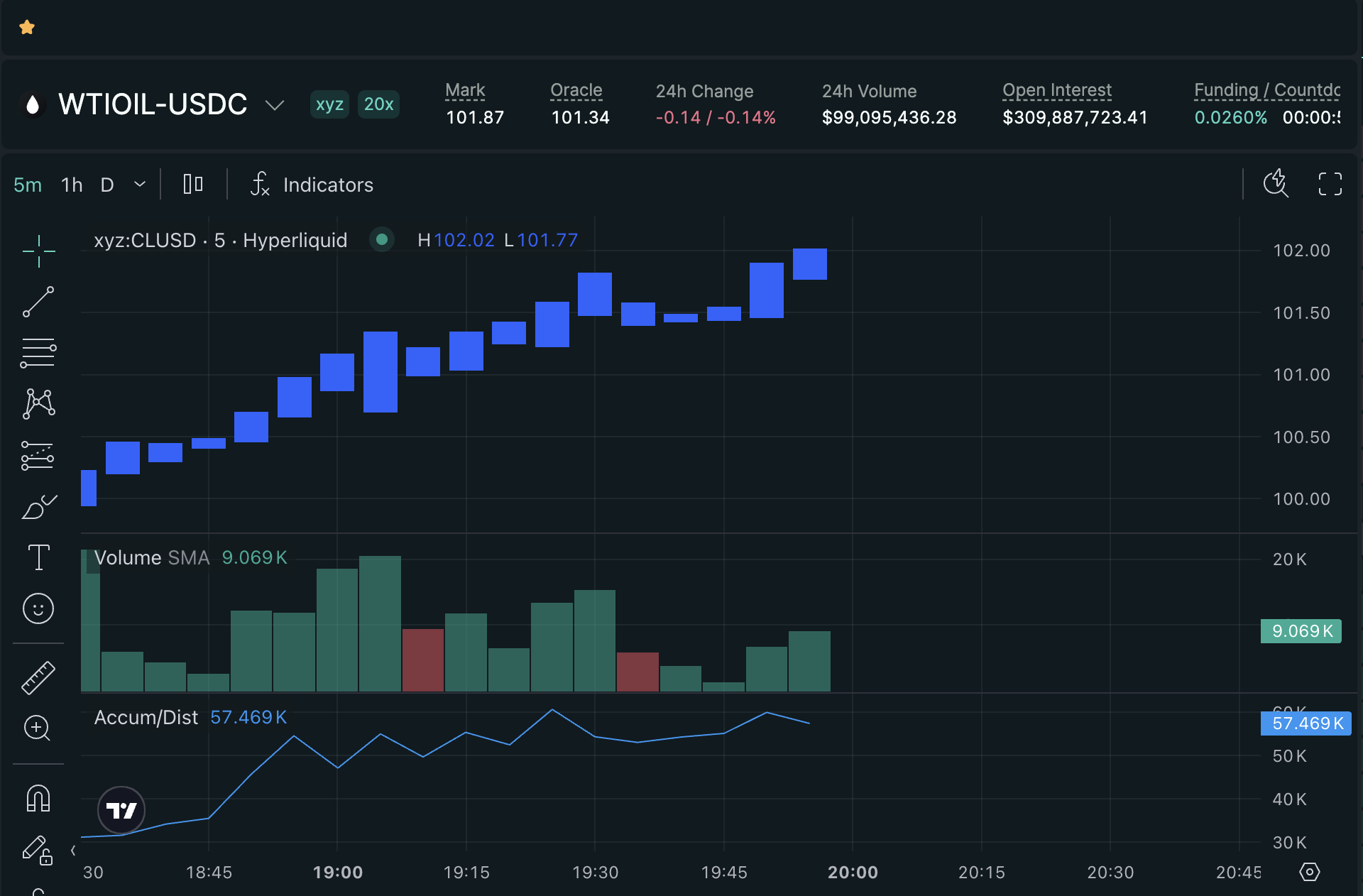
their infra is a 10/10 compared with most venues.
behavior is unusually predictable.
you usually know what happened and why.
that changes the game.
when the venue is bad, losing is easy to explain.
site broke. API lied. book lagged. cancel failed. data was stale. fine.
on Hyperliquid, you lose excuses.
the venue is clean enough that the mistakes become cleaner too.
people use too much size. they chase. they puke. they get liquidated. they re-enter.
sometimes they are right directionally and still wrong structurally.
that is the part that matters.
you are not just trading against views.
you are trading against position design.
Receipt: this is where clean infra becomes dangerous. when the venue behaves properly, the losses are easier to attribute. bad sizing, bad liquidation assumptions, bad flow models, bad discipline. the market stops letting you blame the plumbing.
what’s hard / risky
there are still liquidations, leverage, forced flows, and people doing incredibly dumb things.
obviously.
it’s crypto.
sometimes the liquidation flow gets so large that it becomes the market for a while.
the venue is full of degens.
not only degens, but enough of them.
and that matters.
people use too much size because the venue, the culture, and the dopamine all encourage it.
so they lose even when they’re right directionally.
that’s basically it.
but it creates flow.
bad flow. forced flow. emotional flow. liquidation flow.
yes, the venue is good.
part of why it is good is that a lot of people are doing insane shit with leverage inside a system that actually works.
priority fees are also a real game theory problem.
I haven’t fully solved that one yet.
which is probably why it is interesting.
notes
they’re also pushing into adjacent surfaces like HIP-4 (HIP), outcome contracts, zero open fees, and direct competition with venues that used to feel like different categories.
venue creep makes sense.
but it also makes comparison harder.
Polymarket moving toward perps and Hyperliquid moving toward outcome-like contracts is funny because their infra situations feel so different.
same general arena.
very different machines.
verdict
excellent venue.
hard game.
the infra is good enough that you lose excuses.
if you want edge there, you probably need serious infrastructure, better liquidation and flow models, or enough discipline to avoid becoming part of the flow yourself.
Hyperliquid looks like clean leverage.
the real game is liquidation flow.
Lighter
what it is
a perpetual futures exchange where token staking affects priority.
why it’s interesting
Lighter is one of the cleanest pay-for-priority games I’ve seen.
the simplified version is: staking buys priority.
the details matter, obviously. they always do.
but the important point is that queue position is not just price and time.
priority is part of the trade.
the 0-fee marketing is brilliant because it moves attention away from the deeper priority game.
people see free trading.
the actual question is:
free for whom?
once you see it, everything makes sense.
who’s early. who’s late. who’s actually trading. who’s just feeding it.
a lot of uninformed flow is structurally disadvantaged before the trade even starts.
it is a casino where the queueing rules matter more than the poster says.
but it is a well-designed one.
that’s what makes it good.
your signal can be right and still not matter because someone paid to be earlier than you.
Receipt: if priority can be bought, then the market is not only price-time. that changes fill probability, adverse selection, maker survival, and which strategies are even allowed to work. the edge is not just prediction. it is access to position in the queue.
what’s hard / risky
if you’re not staking heavily, you may be at a structural disadvantage.
not because the venue is broken.
because the venue is doing exactly what it says, just in a way that many traders will underweight.
that is the funny part.
the trap is not hidden because nobody can see it.
the trap is hidden because people are trained to look somewhere else.
notes
their infra is actually good, though.
things behave the way you expect. latency is predictable. nothing randomly breaks.
that matters.
a cursed game with good infra is still a good game.
verdict
I honestly love it.
Lighter looks like free trading.
the real game is paid priority.
Aster
I have not traded Aster seriously yet, so this is more of a read on the game design than a trading postmortem.
what it is
a perp venue layered with every incentive mechanism imaginable: points, boosts, teams, referrals, campaigns, leverage, yield collateral, hidden orders.
why it’s interesting
Aster is weird because it doesn’t feel like a normal venue.
yes, there are perps.
yes, there is collateral.
yes, there are hidden orders, points, boosts, teams, referrals, campaigns, all of it.
but the thing you notice pretty quickly is that the platform is constantly telling people what to do.
trade more volume. hold more size. use this collateral. join this team. refer people. farm points. increase score.
so a lot of the flow is not really coming from people who think the trade is good.
it is coming from people reacting to incentives.
on Hyperliquid, people are overleveraged because they are degens.
on Lighter, people get farmed because priority is pay-to-win.
on Aster, people do weird shit because the dashboard made it look optimal.
and maybe it is optimal.
that is the annoying part.
if everyone is playing the points game, then the edge is not just price prediction.
the edge is understanding the scoring game better than the people doing volume because a leaderboard told them to.
Receipt: incentive flow is not the same as opinion flow. if a venue pays users to create volume, hold size, refer people, join teams, or optimize a score, then the resulting trades are partly about the scoring function. the trade is no longer only “is this price good?” it is “what behavior did the platform just subsidize?”
what’s hard / risky
the hard part is that I am not totally sure how knowable the game is.
my bigger concern is platform risk.
not “the smart contract explodes” risk.
that exists, fine.
I mean the more cursed version:
what game am I actually playing?
with Aster, you are not just trading price.
you are trading a points formula you don’t fully see.
maybe volume matters. maybe size matters. maybe collateral matters. maybe your team matters. maybe they change the weights later.
great.
so now you’re not only making a market bet.
you’re also making a bet on someone else’s spreadsheet.
I hate that this might be interesting.
losing because I was wrong is normal.
fine.
losing because the scoring function moved is a different kind of annoying.
harder to model, harder to hedge, harder to even complain about without sounding like an idiot.
the privacy stuff is interesting too.
hidden orders make sense.
if everyone can see your size, intent, and liquidation, you’re basically naked in a room full of predators.
so I get why they built it.
but it also means the venue is harder to understand from the outside.
which is the Aster trade in miniature.
notes
Aster might be a good trading venue.
it might be a points casino.
the annoying possibility is that it is both.
verdict
I haven’t traded it seriously enough to call this a venue view.
but the incentive surface is weird enough that I probably should.
Aster looks like trading.
the real game is incentives.
Jupiter
what it is
a Solana routing and perps surface.
part aggregator, part trading venue, part execution graph.
why it’s interesting
Jupiter is not interesting in the same way Hyperliquid is interesting.
Hyperliquid feels like a venue.
you send orders, you get filled, you can usually figure out what happened.
Jupiter feels more like plumbing.
you are not really trading one thing.
you are trading through a route, a bunch of accounts, some pools, priority fees, quote freshness, transaction landing, Solana congestion, and whatever random bullshit is happening that day.
which is kind of horrible.
but also interesting.
the aggregator side is basically a live map of fragmented liquidity.
every quote is a little routing problem.
which pools? which hops? how much slippage? how stale is the quote? does the transaction actually land? does the route still exist when it lands?
so the trade is not just:
“am I right on price?”
it’s also:
“can I actually get this thing settled before the path disappears?”
I like that.
unfortunately.
Receipt: routing failures are not abstract. the quote can be real when you request it and gone when you settle it. the route can change, priority fees can move, account state can update, the transaction can fail, or congestion can turn a good trade into a dead one. on routing surfaces, execution risk is not after the trade. it is the trade.
what’s hard / risky
the annoying part is that the failure modes are messy.
on an order book, at least losing is usually legible.
you were slow. too big. too passive. too aggressive. someone picked you off.
fine.
on Jupiter/Solana, sometimes the answer is just:
the route changed.
the quote went stale.
the tx didn’t land.
fees moved.
account state changed.
Solana had a little episode.
you can be right in the quote window and still wrong by settlement.
that’s not a moral complaint.
it’s just the game.
less poker table, more packet routing during a fire.
notes
Jupiter is probably where “execution is research” is the most literal.
the edge is not just having a better view on price.
a lot of it is knowing how the transaction actually gets from intent to settlement.
routing, fees, account state, landing, retries, failure handling.
all the boring stuff that turns out not to be boring.
which is also why it attracts a very specific kind of trader:
people who enjoy fighting infrastructure.
sadly, I am one of those people.
verdict
Jupiter is not my favorite venue yet.
but it might be the cleanest example of why DeFi trading is still interesting.
the market is not just the price.
it’s the route, the latency, the fee market, the state machine, and the failure mode.
Jupiter might be my next addiction.
which is annoying, because the thing is basically adversarial plumbing.
and I think I’m already hooked.
Jupiter looks like routing.
the real game is execution failure.
conclusion
the common thread is that the edge is rarely on the surface.
Polymarket looks like event prediction, but the real game is platform drift. Hyperliquid looks like clean leverage, but the real game is liquidation flow. Lighter looks like free trading, but the real game is paid priority. Aster looks like trading, but the real game is incentives. Jupiter looks like routing, but the real game is execution failure.
I called it a casino, but that is not quite right.
casinos tell you the rules.
these systems are more interesting than casinos because the rules are partly technical, partly social, partly economic, partly hidden, and partly changing while people trade them.
that is why the API matters.
the API is not just access.
it is the surface where the real game leaks out.
the thing I keep coming back to is that these systems are not interesting because they are crypto.
they are interesting because they are adversarial, programmable markets with broken edges.
some people see that and call it chaos.
fair.
I see it and think: okay, finally, a market where the plumbing matters.
anyway.
I still like money and computers.
Terms: perps, MEV, CLOB, routing, platform drift, edge
If you’re working on something weird, technical, adversarial, and tradable, say hi.
especially if it is probably a bad idea.